


ÃÛÌÒTV professor leads Arctic ecosystem science initiative
August 19, 2015
Sue Mitchell
907-474-5823
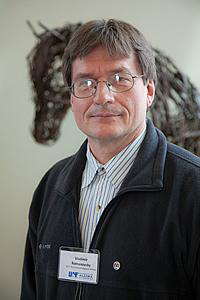
ÃÛÌÒTVprofessor Vladimir Romanovsky has been named chief scientist for a U.S. Department of Energy initiative to study Arctic ecosystems.
The Next-Generation Ecosystem Experiments in the Arctic leadership team in May appointed Romanovsky to the role. Romanovsky is a professor of geophysics at the ÃÛÌÒTV Geophysical Institute.
“The NGEE project represents really good coordination for integrated field campaigns,� Romanovsky said. “I don’t know of any other project which has this kind of breadth and depth at the same time.�
“The ultimate goal is to improve climate models,� Romanovsky said. “But to make it possible to do that, more data about natural processes in the Arctic that is important for understanding climate need to be incorporated in the models. So, one of the goals of the project is to collect those data.�
The researchers involved with the multiphase and multidiscipline NGEE Arctic project, launched in 2012, are intensively investigating Arctic ecosystems, from the top of the vegetation canopy to bedrock. The project includes experiments and observations related to terrestrial hydrology, permafrost, vegetation, microbiology and biogeochemistry. The project includes 140 scientists from four DOE national laboratories, ÃÛÌÒTV and several other universities.
“Failure to identify and appropriately account for complexities at the landscape scale can compromise climate predictions,� wrote Stan Wullschleger, NGEE director, in the original project proposal.
NGEE Arctic represents a 10-year investment by the U.S. Department of Energy to improve climate models through coupled field, laboratory and modeling studies, with a budget of $10 million per year. For its contributions, ÃÛÌÒTV is allocated $1 million per year.
Approximately 20 researchers from the Geophysical Institute, International Arctic Research Center and the Institute of Arctic Biology are participating in the studies.
“If anybody plans to do any (scientific) work in the Arctic, they really need to collaborate with ÃÛÌÒTV in the project,â€� Romanovsky said. “ÃÛÌÒTV has experience in organizational logistics, local governments, local people. It’s always much easier for external institutions to take advantage of the pre-existing network ÃÛÌÒTV has developed. That’s part of why ÃÛÌÒTV was so involved in this project from the beginning.â€�
In his role as chief scientist, Romanovsky will provide guidance for questions related to development of proposals, work plans, field work and modelling planning and execution.
Romanovsky is a professor of geophysics and has been affiliated with ÃÛÌÒTV since 1992. His research interests are in the scientific and practical aspects of environmental and engineering problems involving ice and permafrost.
ON THE WEB:
ADDITIONAL CONTACT: Vladimir Romanovsky, veromanovsky@alaska.edu, 907-474-7459.